
Short answer: yes. YouTube does not refuse monetization just because a video is narrated by an AI or text-to-speech voice. Channels lose monetization when the video as a whole is generic, templated, mass-produced or a reading of material the creator did not write. The voice is rarely the problem — the content behind it is.
This guide summarizes what YouTube's own policy pages say, so you can decide whether an AI voice channel is a safe plan. Policies change, so always check the linked YouTube pages before you build a channel around them.
What YouTube's monetization policy actually says
Monetization in the YouTube Partner Program (YPP) is governed by the YouTube channel monetization policies. On July 15, 2025 YouTube renamed its "repetitious content" rule to "inauthentic content". The rule is about whether a video adds something original — not about which tools made it.
According to that page, these are examples of content that cannot be monetized:
- Image slideshows, templated storylines, or scrolling text with minimal or no narrative, commentary, or educational value.
- AI-generated content made with generic or unoriginal templates that gives the impression of mass production.
- Content that exclusively features readings of other materials you did not originally create — for example, an AI voice reading a news article or a book chapter word for word.
- Videos that stitch together unrelated AI clips to surprise or shock viewers.
- AI personas that present themselves as human experts on sensitive topics such as health, legal, finance or politics.
The same page lists things that are allowed, including using AI to edit scripts or create background visuals when the result reflects your own creative vision, and series that share a format but give each video a distinct storyline or focus.
An AI voice is a tool, like a microphone
Nothing in the policy singles out synthetic narration. What reviewers look at is whether a viewer gets something they could not get from a thousand near-identical videos. An AI voice reading your own researched script, with your own structure, examples and opinion, is in a very different position from an AI voice reading a Wikipedia page over stock footage.
A useful test: if you replaced the AI voice with your real voice, would the video still be original? If yes, the voice is not what puts monetization at risk. If no, a better voice will not save it.
Do you have to disclose an AI voice?
Disclosure is a separate rule from monetization. YouTube's altered or synthetic content policy asks creators to tick the disclosure box when realistic content could mislead viewers. Disclosure is required when content:
- Makes a real person appear to say or do something they didn't do.
- Alters footage of a real event or place.
- Generates a realistic scene that didn't actually occur.
- Creates music that is the main focus of the video.
The same page says disclosure is not required for production assistance such as using AI to write or improve a script, outline or thumbnail, or for cloning your own voice to create voiceovers or dubs. A stock AI narrator that does not imitate a real person is not one of the listed cases — but if a voice could make viewers believe a specific real person is speaking, you must disclose it, and you should never imitate someone without permission.
Why AI voice channels actually get demonetized
When AI voice channels are rejected or lose YPP, the patterns usually match the examples above:
- Re-reading other people's content: Reddit stories, news articles, book summaries or scripts copied from other videos, narrated as-is.
- One template, hundreds of uploads: the same structure, the same stock clips and only the topic changes — the "mass production" signal.
- No narrative or commentary: slideshows or scrolling text where the voice adds nothing that the screen does not already show.
- Reused footage: clips taken from other YouTube channels or online sources without meaningful transformation.
Checklist for a monetizable AI voice channel
- Write your own script. Use AI to help outline or edit if you like, but the ideas, examples and order should be yours.
- Add something viewers can't get elsewhere: your opinion, a comparison, a tutorial you tested, local context, data you collected.
- Vary each video: a recurring intro is fine; a recurring script with only the nouns swapped is not.
- Use visuals that support the narration — screen recordings, your own footage, diagrams — instead of unrelated stock clips.
- Pick one consistent voice for the channel so it becomes recognisable, and use natural pacing (see our guide to free text to speech for YouTube).
- Disclose whenever the content could make viewers think a real person said something they did not.
- Keep your rights clean: use audio and footage you are allowed to use commercially.
"AI voice YouTube channel monetization hoga ya nahi?"
This is one of the most searched versions of the question in India. The answer is the same in every country: yes, it can be monetized if the channel meets the normal YPP requirements and each video is original. Hindi, Bangla or Urdu narration with an AI voice is treated exactly like English narration. If you are starting a Hindi channel, our Hindi text to speech guide walks through the voiceover step by step.
FAQ
Will YouTube detect that my voiceover is AI?
It does not matter much. The monetization review asks whether the content is original and valuable, not whether a human recorded the audio.
Can I use an AI voice for YouTube Shorts?
Yes, the same rules apply. Shorts that are templated or re-read other people's text face the same monetization limits as long videos.
Is AI voice content "reused content"?
No. Reused content means repurposing material that already exists on YouTube or elsewhere. Narrating your own original script with an AI voice is new content.
Where can I make an AI voiceover for free?
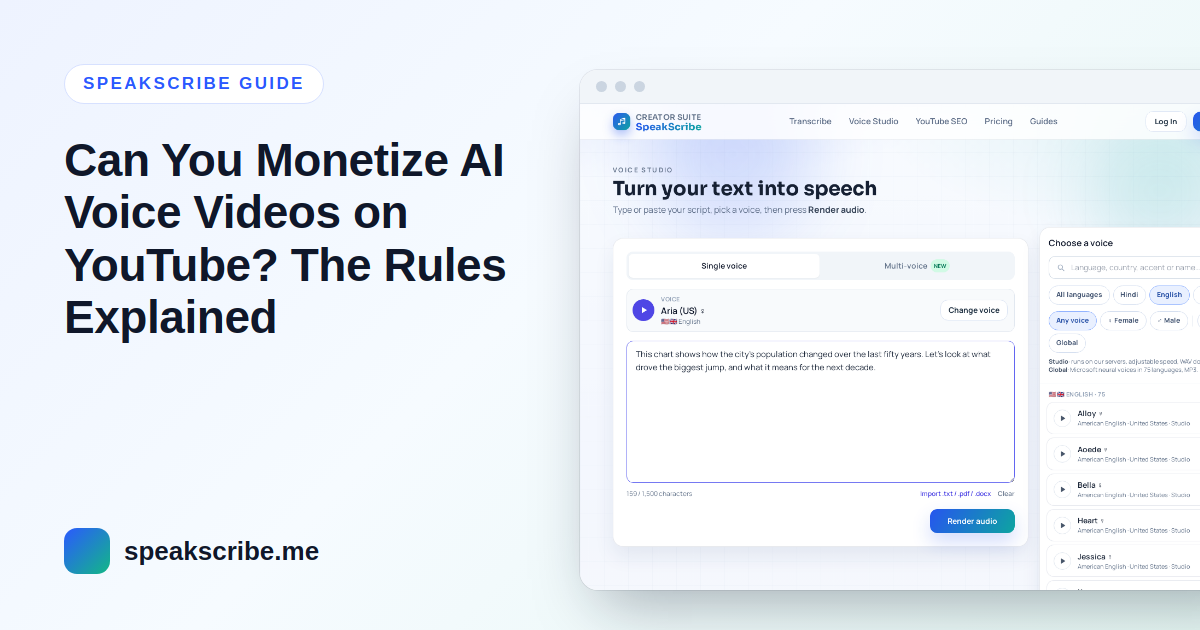
You can try voices in SpeakScribe's Voice Studio without an account; a free account includes 10 voice generations a month.